
Search Results: objects
Show search help


Jug with epigraphic decoration
-
Details
- Associated place
- Date
-
2nd half of the 12th century - early 13th century
Great Seljuq Period (1040 - 1194)
- Material and technique
- fritware, with moulded decoration under a turquoise glaze
- Dimensions
-
21.6 cm (height)
15 cm max. (diameter)
at mouth 9.2 cm (diameter)
- Material index
- Technique index
- Object type index
- No. of items
- 1
- Credit line
- Bequeathed by Professor A. H. Sayce, 1935.
- Accession no.
- EAX.3110
-
Further reading
Allan, James W., Islamic Ceramics, Ashmolean-Christie's Handbooks (Oxford: Ashmolean Museum, 1991), no. 8 on p. 18, illus. p. 19
Glossary (2)
fritware, glaze
-
fritware
Ceramic material composed of ground quartz and small quantities of clay and finely ground frit (frit is obtained by pouring molten glass into water).
-
glaze
Vitreous coating applied to the surface of a ceramic to make it impermeable or for decorative effect.
Location
-
-
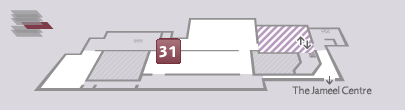
First floor | Room 31 | Islamic Middle East
-
First floor | Room 31 | Islamic Middle East
Objects are sometimes moved to a different location. Our object location data is usually updated on a monthly basis. Contact the Jameel Study Centre if you are planning to visit the museum to see a particular object on display, or would like to arrange an appointment to see an object in our reserve collections.
Collection trails

Galleries

Publications online
-

Islamic Ceramics
After initially using the stone-paste body to imitate the white Chinese porcelains, the Islamic potter in his accustomed way started to add colour. First he added a single colour to the glaze – cobalt for blue (no. 7 [EAX.1206]), manganese for purple, or, as here, copper for turquoise. In a lead glaze copper turns green (no. 4 [EA1974.48]), but in the alkaline glazes used on stone-paste it turns turquoise, and it is this turquoise which has been the hall-mark of Persian ceramics and tiled domes ever since its introduction in the eleventh – twelfth century.
The design on the jug is calligraphic, using stylised kufic script. Calligraphy was of far more importance in Islamic culture than in the Christian west. The Arabic text of the Koran was considered to be a transcription of an eternal Koran, written in Arabic, kept in Heaven. The words and letters thus had a holiness of their own. Taken alongside the antipathy towards the use of images in a strictly religious context (p.4 [Introduction]), this explains why the decorative possibilities of the Arabic script were so fully explored by Islamic artists, and accounts for the popularity of calligraphic designs, in media, like ceramics, less suited to them. Here the Arabic words for ‘glory’ and ‘prosperity’ gives the impression of having been designed by an illiterate craftsmen. His customers, however, would have been uplifted by the presence of Arabic script on their purchases, and even if they too were illiterate, would have taken it as symbolising the good wishes which were the potter’s original intention.
© 2013 University of Oxford - Ashmolean Museum