
The A. H. Church Collection of Japanese Sword-Guards (Tsuba)
An unpublished catalogue of the A. H. Church collection of Japanese sword-guards (tsuba) by Albert James Koop.
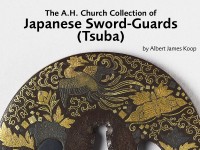
Publications online: 71 objects
Show search help
Tsuba depicting five flying birds
-
Literature notes
Iron boldly grained. In low relief are five flying birds (chidori), two of them at the back; gold dots for eyes; edge irregularly hammered up. Signed: Ki no kuni ("of Kii province or Kishū") Baibaidō [Japanese text] Masayoshi [Japanese text] with gold-inlaid seal Uyeda ([Figure], i.e. [Japanese text] "made this of foreign or imported iron").
In the Matt Garbutt Collection there was a plain grained iron guard signed Masayoshi (as here) "of [Japanese text] Kii-shū (sic)".
Chidori (literally "thousand, i.e. innumerable, birds") are little birds of indeterminate genus (petrels?), commonly depicted in Japanese art as flying over waves (here the graining may be intended to represent these); they are popularly supposed to be born of the wave-crests. -
Details
- Associated place
- Date
- 19th century (1801 - 1900)
- Material and technique
- iron, with gold, and hammered-up edge
- Dimensions
- 7.6 x 7.3 cm (height x width)
- Material index
-
processed material › metal › iron,
- Technique index
- Object type index
-
arms/armour › koshirae › kodogu › tsuba
- No. of items
- 1
- Credit line
- Bequeathed by Sir Arthur H. Church, 1915.
- Accession no.
- EAX.11210
-
Further reading
Koop, Albert James, The A. H. Church Collection of Japanese Sword-Guards (Tsuba), 3 vols (Oxford, Ashmolean Museum, 1929), no. 1210
Glossary
tsuba
-
tsuba
Japanese sword guard.
Location
-
- currently in research collection
Objects are sometimes moved to a different location. Our object location data is usually updated on a monthly basis. Contact the Jameel Study Centre if you are planning to visit the museum to see a particular object on display, or would like to arrange an appointment to see an object in our reserve collections.
Publications online
-

The A. H. Church Collection of Japanese Sword-Guards (Tsuba)
Iron boldly grained. In low relief are five flying birds (chidori), two of them at the back; gold dots for eyes; edge irregularly hammered up. Signed: Ki no kuni ("of Kii province or Kishū") Baibaidō [Japanese text] Masayoshi [Japanese text] with gold-inlaid seal Uyeda ([Figure], i.e. [Japanese text] "made this of foreign or imported iron").
In the Matt Garbutt Collection there was a plain grained iron guard signed Masayoshi (as here) "of [Japanese text] Kii-shū (sic)".
Chidori (literally "thousand, i.e. innumerable, birds") are little birds of indeterminate genus (petrels?), commonly depicted in Japanese art as flying over waves (here the graining may be intended to represent these); they are popularly supposed to be born of the wave-crests.
Notice
Object information may not accurately reflect the actual contents of the original publication, since our online objects contain current information held in our collections database. Click on 'buy this publication' to purchase printed versions of our online publications, where available, or contact the Jameel Study Centre to arrange access to books on our collections that are now out of print.
© 2013 University of Oxford - Ashmolean Museum